The Most Expensive Mistake Is Making the Wrong Choice
Spending $900 to repair a 15-year-old air conditioner that fails again eight months later is a painful lesson. So is replacing a 7-year-old system that only needed a $250 capacitor. When Orange HVAC technicians assess a malfunctioning system during an AC repair call in Encino or West Hollywood, we give homeowners the honest numbers they need to make an informed decision — not the answer that maximizes our invoice for that visit.
The 50% Rule: A Useful Starting Point
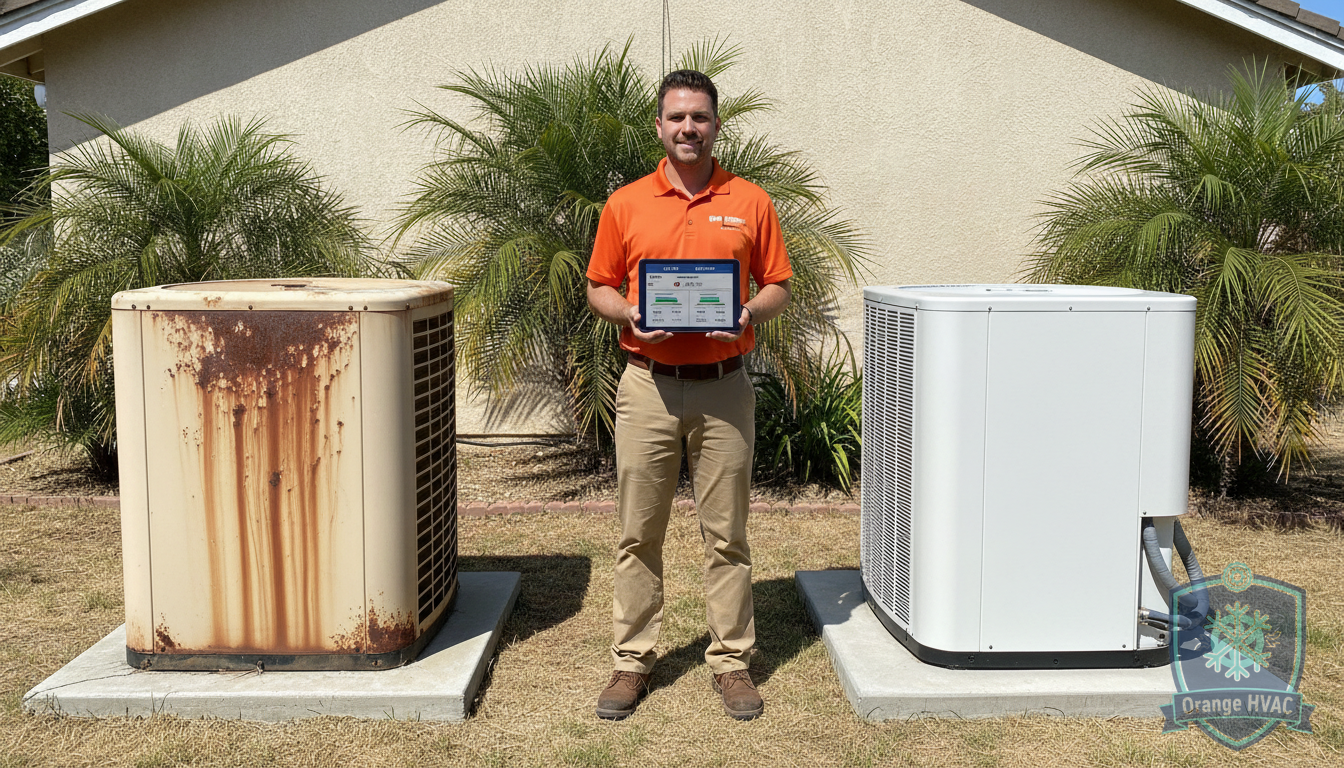
One widely used guideline in the HVAC industry is the 50% rule: if the cost of the repair exceeds 50% of the cost of a comparable new system, and the existing unit is more than 10–12 years old, replacement typically makes more financial sense over a 3–5 year horizon. Here's why the age factor matters so much:
- Compressors, heat exchangers, and condenser coils become increasingly prone to failure after 10–12 years of Southern California use, where systems run more months per year than in cooler climates.
- Older systems are almost always less efficient than modern equipment. A 15-year-old unit likely has a SEER rating of 10–13. Today's minimum federal standard for California is 15 SEER2, and high-efficiency systems reach 20+ SEER2. The energy savings from a new system can offset a significant portion of the installation cost over time.
- Parts for older systems — particularly compressors and coil assemblies — become harder to source and more expensive as the equipment ages.
The R-22 Refrigerant Factor
If your existing air conditioner uses R-22 refrigerant (commonly called Freon), that is a critical replacement consideration. R-22 was phased out under EPA regulations and is no longer manufactured in the United States. Remaining supplies are recycled and expensive — a refrigerant recharge for an R-22 system can cost several times more than the same service on a modern R-410A or R-32 system, and recharging a leaking R-22 system without finding and fixing the leak is money that disappears quickly. If your system uses R-22 and has a refrigerant leak, replacement with a modern system is almost always the better financial choice.
Repairs That Are Almost Always Worth Making
On the other hand, several common repairs make clear economic sense even on older equipment if the rest of the system is in reasonable condition:
- Capacitor replacement — One of the most common AC failures, typically costing $150–$300. Capacitors are inexpensive parts that can fail on even relatively new systems.
- Contactor replacement — Similar cost range, and a straightforward repair that restores normal operation quickly.
- Thermostat replacement — If a malfunctioning thermostat is causing erratic system behavior, a new thermostat installation is a low-cost fix that can make the system feel like new.
- Condensate drain clearing — A clogged drain line is a maintenance issue, not a mechanical failure, and costs very little to address.
- Blower motor replacement on a younger system — If the system is under 8 years old, replacing a failed blower motor is usually cost-effective since the compressor and coils likely have years of service life remaining.
When Replacement Makes Undeniable Sense
There are situations where our technicians will recommend replacement clearly and without hesitation:
- A cracked heat exchanger on a gas system — operating a furnace with a cracked heat exchanger creates a carbon monoxide risk, and the repair cost typically approaches or exceeds replacement cost. See our heating system repair page for more on this safety issue.
- A failed compressor on a system over 10 years old — compressor replacement is expensive, and if the system is approaching end of life, you're paying near-replacement cost to extend a failing system's life by a few uncertain years.
- Repeated refrigerant leaks — if a system has been recharged multiple times and the leak source cannot be reliably repaired, continuing to service it is throwing good money after bad.
Getting a New System Installed in Encino or West Hollywood
If replacement is the right call, Orange HVAC handles every step of the AC installation process — from load calculations and permit applications to condenser pad preparation, refrigerant line installation, and system commissioning. We follow California Title 24 energy codes and manufacturer specifications on every installation. Homeowners in Sherman Oaks, Reseda, and Studio City can expect the same transparent pricing and thorough process.
Talk to a Technician Who Will Be Honest With You
The best way to get a clear repair-versus-replacement answer for your specific situation is to have a qualified technician inspect the system and give you documented findings. Orange HVAC provides upfront written estimates before any repair work begins, and we'll tell you exactly what we found, what it costs to fix, and what a comparable new system would cost — so you can decide with full information. Call us at (818) 936-5449 or request a diagnostic visit online. We're available seven days a week, 8 AM to 6 PM.
Confirm Availability
Call +18189365449 or fill out our online form for a free, no-obligation quote.
Request Free Quote